
Landlord-tenant law.
It's all we do.
Focused legal counsel for rental property owners, property managers, and real estate professionals navigating California's increasingly complex housing laws.

The law changes.
Our core values do not.
A practical, business-minded approach to representing rental property owners.
Business-Minded Counsel
We understand the economics of rental property ownership. Our advice considers the bigger picture, balancing legal strategy, cost, risk, and long-term financial impact.
Focused Expertise
Landlord-tenant law is all we practice. That singular focus allows us to provide informed guidance in an increasingly complex regulatory environment.
Client Loyalty
We recognize the challenges property owners face and advocate for their interests with commitment, understanding, and resolve.
Prompt Action
Landlord-tenant problems rarely improve with time. We address issues early and directly, before manageable problems become costly disputes.
Pragmatic Negotiation
Not every dispute belongs in a courtroom. We pursue practical resolutions and negotiate strategically when doing so serves our clients' interests.
Resolution Over Conflict
Our objective is to solve problems, not prolong them. We emphasize efficient, cost-conscious outcomes over unnecessary confrontation and litigation.
Our clients say it best.
Legal challenges can be complicated, costly, and personal. Here's what the people we've represented have to say about working with Bornstein Law.
We felt confident and supported, knowing we were in capable hands.

NEWSROOM
We raise the voice of rental housing providers.
Rental housing providers often find their perspective missing from the public conversation. Bornstein Law brings decades of experience to that conversation, explaining the legal and practical realities facing property owners.
Media outlets regularly call on Daniel Bornstein to provide perspective on the issues affecting Bay Area rental housing.
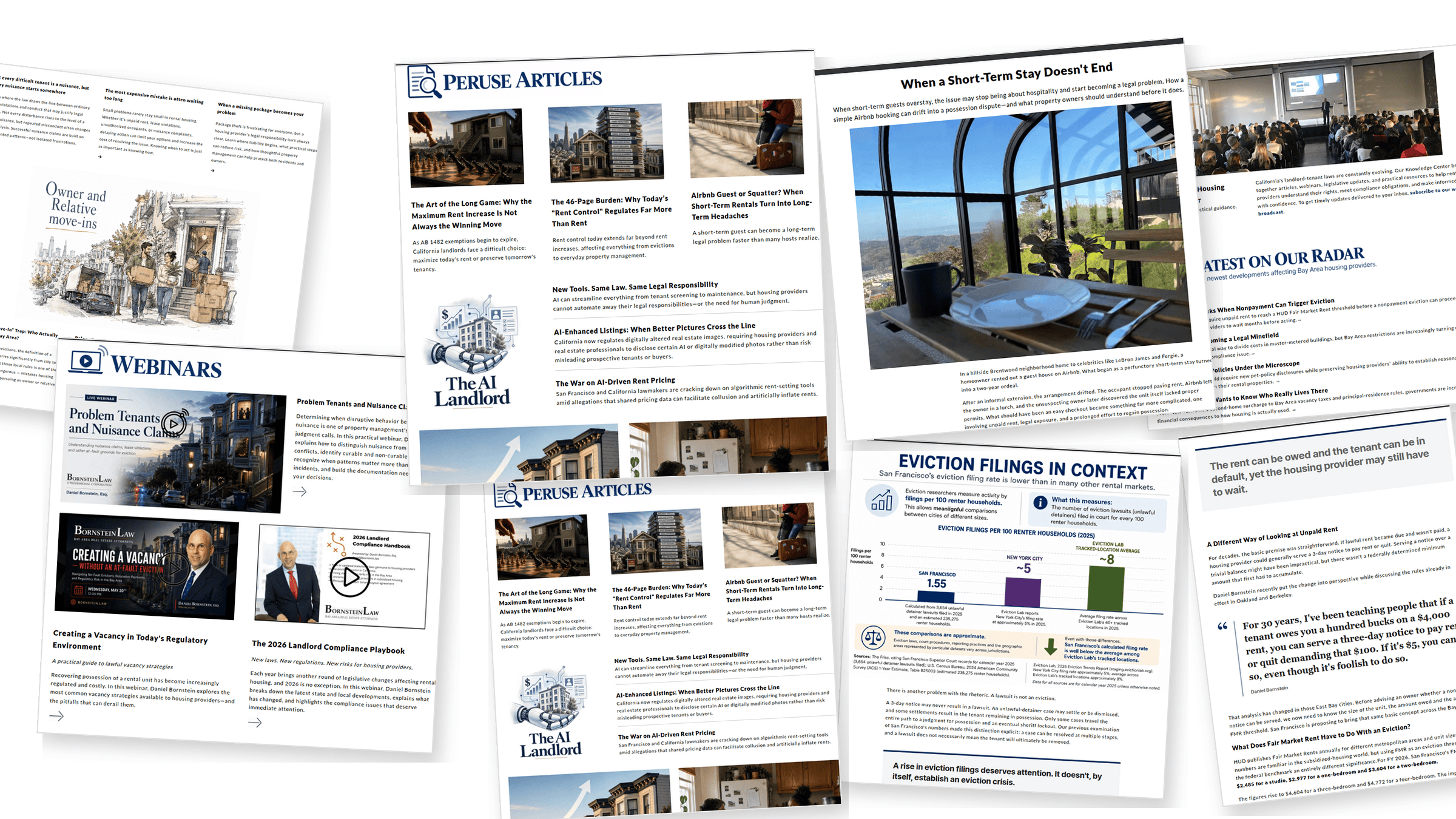
Knowledge Is the First Line of Defense
Bornstein Law has long been committed to educating the rental housing community. Our Resource Center brings together practical guidance, legal insights, webinars, and analysis to help housing providers navigate an increasingly complex regulatory environment.

AT A GLANCE
Practice Areas
During the lifespan of a tenancy, residents have ample opportunity to violate the lease or engage in behavior that may justify eviction under state and local laws. Beyond nonpayment of rent, grounds may include nuisance or criminal activity, unauthorized subletting or alterations, denying lawful entry, and other breaches of the lease.
When eviction is neither available nor practical, landlords and tenants may negotiate a voluntary surrender of possession in exchange for compensation. A properly prepared tenant buyout agreement can resolve claims arising from the tenancy and allow the owner to recover possession. In cities such as San Francisco, Oakland, Richmond, and Berkeley, these agreements are highly regulated and require careful compliance with local rules.
Rising operating costs often lead rental property owners to consider rent increases, but state and local laws may limit both the amount and frequency of those increases. Many Bay Area jurisdictions impose additional restrictions beyond statewide requirements. Proper calculation, timing, and notice are essential before implementing any rent increase.
Lease agreements should evolve with changes in the law and the tenancy. Outdated leases may fail to address new living arrangements, property rules, or important owner protections. We review and draft rental agreements to promote clarity, reduce liability, and identify gaps that may be addressed through properly noticed changes to the terms of the tenancy.
In certain circumstances, owners may recover possession of a rental unit through no fault of the tenant, such as an owner or relative move-in, withdrawal from the rental market, substantial renovations, or compliance with a government order. No-fault evictions are highly regulated and may involve strict procedural requirements, notice obligations, and relocation payments.
Tenants may bring claims involving habitability, rent increases, wrongful eviction, retaliation, harassment, housing discrimination, and other alleged violations of state or local law. Bornstein Law defends rental property owners against tenant litigation with a focus on resolving disputes efficiently while protecting the owner’s legal and financial interests.
SMART LAWYERING.
SOUND BUSINESS JUDGMENT.
We don't just ask what the law allows. We ask what makes sense for you and your real estate investment—taking into account your goals, the economics, the risks, and the most practical path forward.
Owning rental property in California has never been simple, and today housing providers operate in one of the most complicated regulatory environments in the country.
For nearly three decades, my practice has been devoted to helping housing providers, property managers, and real estate professionals navigate that environment intelligently. As a real estate investor myself, I tend to look at landlord-tenant problems differently. A technically correct legal answer isn't always the best business answer.
Every strategy has a cost, every dispute carries risk, and every decision should be considered in the larger context of the property and the investment. That's why our conversations often begin with a simple question: Where do you need to end up?
From there, we determine the most sensible way to get there.
More about our founding attorney →

STAY AHEAD OF CALIFORNIA RENTAL HOUSING LAW
Practical guidance, legal updates, webinars, and new resources from Bornstein Law.